 ↗
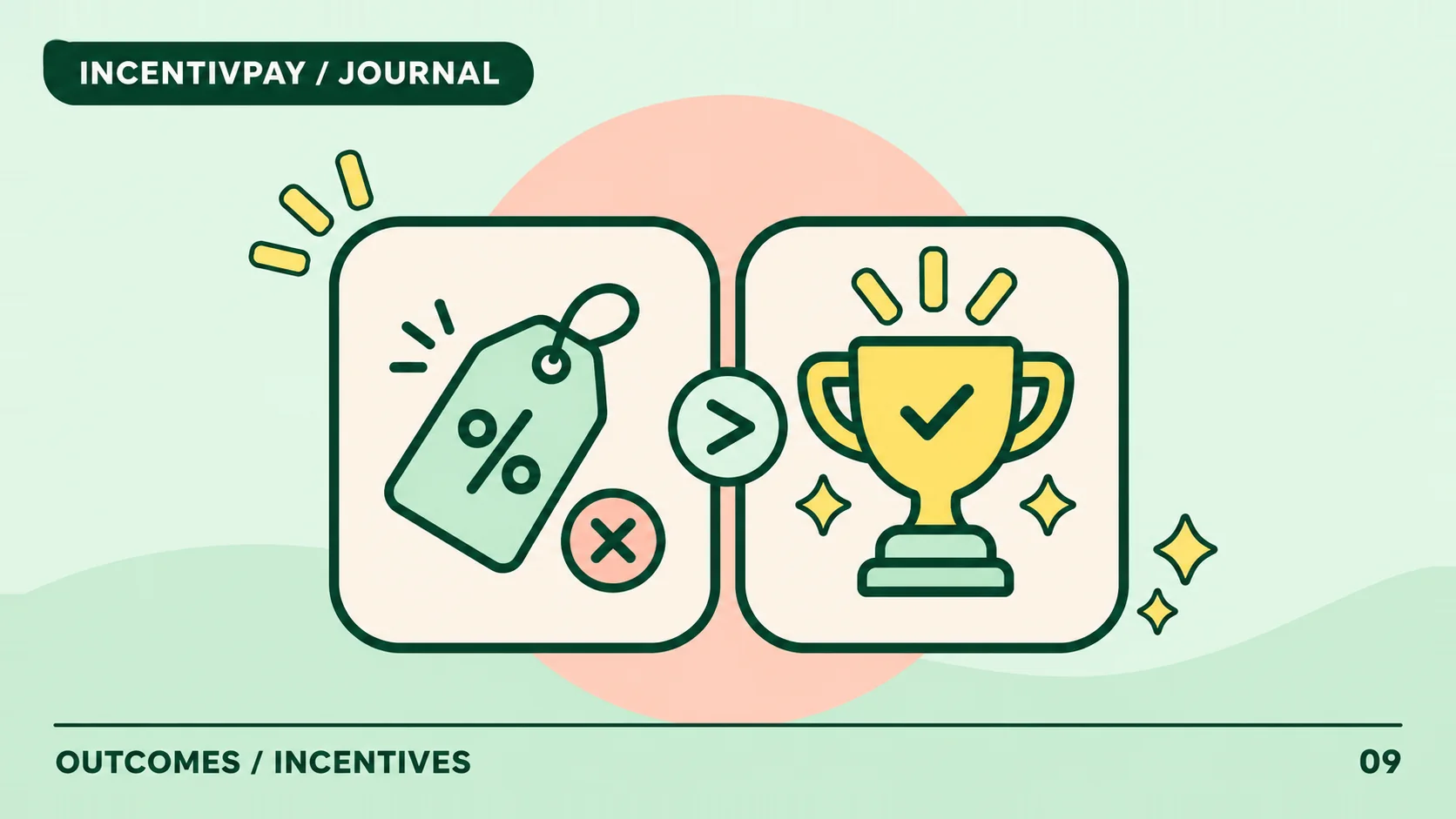
Blanket discounts train shoppers to wait, erode brand equity, and quietly destroy margin. Outcome-based incentives flip the model — rewarding shoppers only when they take the actions that grow your business. Here is the data, the psychology, and the playbook.
For two decades, the default ecommerce growth lever has been the same: discount harder. 10% off the first order. 20% off the cart. Free shipping over $50. It works — until it doesn't. By 2026, the average DTC brand spends 14–22% of revenue on promotional discounts, and customers have been trained to never pay full price.
A new model is replacing the blanket discount: outcome-based incentives. Instead of giving every shopper a guaranteed markdown, merchants offer a conditional reward tied to a real-world outcome — a sports result, a weather event, a delivery milestone, or a subscription renewal. The result: higher conversion, protected margins, and a checkout experience customers actually talk about.
1. The Hidden Cost of Discount Addiction
Every time you run a 20% off promotion, three things happen:
- You compress margin on customers who would have paid full price. Studies show 60–70% of discount redeemers were already going to convert.
- You anchor future expectations. Once a shopper sees 20% off, they wait for it next time.
- You devalue your brand. Premium positioning and constant promotions cannot coexist.
The math is brutal: a 20% discount on a 40% gross-margin product cuts contribution margin in half. You need to double conversion just to break even.
2. What "Outcome-Based" Actually Means
Outcome-based incentives reward the shopper only if a defined event happens after the purchase. Examples:
- "Your order is free if the home team wins this weekend."
- "Get 100% credit back if it rains on delivery day."
- "Bonus product on your 3rd subscription renewal."
The shopper pays full price today. The brand only funds the reward in the subset of cases where the outcome triggers — typically 15–35% of orders. The expected cost is materially lower than a blanket discount, while the perceived value is dramatically higher.
3. The Behavioral Economics Behind the Lift
Three well-documented biases make outcome-based incentives convert better than equivalent-value discounts:
- Possibility effect: humans overweight small probabilities of large gains. A 25% chance of a free order feels more exciting than a guaranteed 10% off.
- Narrative transportation: tying a reward to a real-world event (a game, a forecast) makes the purchase memorable and shareable.
- Loss aversion is bypassed: the shopper still pays full price, so they don't feel they're "losing" the discount they could have negotiated.
4. The Margin Math, Side by Side
Take a $100 order at 50% gross margin.
- Blanket 15% discount: margin per order drops from $50 to $35 — a 30% margin hit on every conversion.
- Outcome-based "free if X happens" with 25% trigger probability: expected payout is $25 per order — but only on the 25% of orders that trigger. Effective margin remains $37.50, and conversion lifts more.
Net result: comparable expected cost, higher conversion, no anchoring, no brand dilution.
5. A 4-Step Playbook to Get Started
- Audit your current discount spend. Calculate the % of revenue going to promotions and the conversion lift attributable to each.
- Pick one trigger event. Start with something culturally relevant to your audience — a major sporting event, seasonal weather, or a subscription milestone.
- Run a controlled A/B test. Split traffic between your usual discount and an outcome-based offer of equivalent expected value. Measure conversion, AOV, margin, and repeat rate.
- Scale the winner. The brands we work with typically see 8–15% conversion lift and 20–40% margin recovery within 60 days.
The Takeaway
Discounts were the right tool for an earlier era of ecommerce — when traffic was cheap and shoppers were less sophisticated. In 2026, the brands that win are the ones that make every checkout interaction feel like a moment instead of a markdown. Outcome-based incentives aren't a replacement for great products or strong brand. They're the conversion layer that lets great brands stop trading margin for growth.
Want to see what an outcome-based incentive would look like in your checkout? [Book a 15-minute pilot walkthrough](/book).